practical phd

a transparent source for all things PhD

Most Sociology PhD programs include a paper requirement such as a “second year paper” or a “Master’s paper.”  This paper serves, in part, a practical purpose of making sure PhD students have an empirical manuscript drafted early in their program that they can mould into a sole-authored journal publication before they go on the job market.  This is an essential part of professionalization as today’s tenure-track job market is so competitive that ABD applicants need at least one sole-authored publication to land a tenure-track job.  This in and of itself is a practical and useful part of the professionalization process.  However, many programs pair this with unreasonable expectations on where early scholars should publish: top tier journals.  “Failing” to land a top tier journal publication can make graduate students feel a severe version of imposter syndrome, that they aren’t cut out for academia, even though all well-established academics frequently receive rejections from these journals as well.  

As a graduate student, I frequently heard that my goal should be a publication in one of the two highest ranked sociology journals: American Journal of Sociology (AJS) or the American Sociological Review (ASR).  If that didn’t work out, a publication in the next two in rankings, Social Problems and Social Forces, would also be acceptable. The last resort was to submit to a subfield journal, but only if submitting to the first four journals did not lead to a publication.  There were certainly faculty who suggested subfield journals over generalist, but the overarching narrative in the program was “top tier or bust.”  

I’m pretty sure this is not a unique feature to Berkeley Sociology as you can see this type of advice in some of the recent Sociologica articles about publishing, which you should read all of if you haven’t already.  Along with other helpful advice about publishing, Fligstein notes: “After putting in hundreds or even thousands of hours, your published work can go completely ignored if it appears somewhere where audiences are sparse. Given this problem, it is important for young scholars to find their way into the best outlets they can. Journals like the American Sociological Review have over ten thousand potential viewers while edited volumes may sell as few as 300 copies that mostly end up in libraries.”  Similarly, Lamont says: “At the start of a career, you have no choice; if you want to be a part of the disciplinary conversation you have to go for the journals that have the most visibility.”  Both Fligstein and Lamont make similar arguments that junior scholars need to enter the literature in highly visible spaces.  

Junior scholars of course need to be seen and heard to help them land tenure-track jobs and earn tenure, but I have two gripes with this advice.  The first is that this advice makes it seem as if young scholars should always target the top tier journals, which in sociology are “generalist” journals.  But even the most established scholars never only publish in generalist journals.  Check any CV for a big name in your field and you’ll see a wide range of placements including subfield journals, edited volumes, and top tier journals.  In disciplines where the top tier journals are meant for a “general” audience of that discipline, this advice is particularly fraught since not every paper is meant for a generalist audience.  Some conversations are most relevant to the subfield and make important contributions to advancing how a subfield thinks and works, so why spend the time and energy trying to convince a general audience that a subfield conversation is interesting?  It is definitely a useful skill to be able to frame your research for both generalist and specialist audiences, but it’s also useful to know when a specialist framing is a better approach than a generalist framing. 

My second gripe is that this advice is often given to early graduate students, as was my experience.  That early in a graduate career, students are still learning to write for an academic audience and to write for their discipline.  To set the expectation that these students place their first (or maybe second) academic research paper at a top tier journal is a stretch at best.  Top tier journals are at the top in part because they are exclusive. They get a lot of submissions and accept very few. Setting the bar that high can mean students who “only” place in subfield journals feel like they won’t make it in academia despite that subfield publications are a valued contribution to the field.  

While some graduate students are able to accomplish top tier publications, it is often students in more privileged positions.  Placement at this early career point is only possible with a combination of a lot of support, guidance, and feedback from one or more faculty members, and the graduate student having a lot of time to analyze, write, revise, and edit.  Programs that are small and have generous funding not attached to teaching tend to have more graduate students who can accomplish this.  

So what advice would I give instead?  Make a list of all of your works-in-progress and ideas.  Think about what audience each paper is engaging and decide whether each is best suited for a generalist or specialist audience.  It is always good to have at least one paper in the works or in mind that would be well-suited for a generalist audience. If all the others are really for specialists, that is both fine and normal!  

Next, think about the paper that is the closest to going out the door and make a list of the journals that match the paper well.  This should be a list of 4-8 journals, all of which you would be happy to have your work published in. When your paper is ready, submit it to the best journal on that list and work your way down in prestige as you get rejected.  Since every journal on the list is one you would be happy to see your work published in, you’ll be happy with your placement when it happens.  

Finally, always remember that rejection is a normal part of the publishing process.  The only people who aren’t getting rejections are the ones who aren’t submitting their papers to journals.  When it happens, it doesn’t mean your paper isn’t worth publishing ever. It just means it’s either not a good fit for the journal you sent it to or it needs some more work before it will be publishable.  Make revisions, get more feedback, and submit it again. Don’t give up!  
There’s an inherent tension with being a faculty of color in a Predominately White Institution (PWI).  Faculty of color face higher demands than their white colleagues in terms of mentoring, advising, and counseling due to the underrepresentation of non-white faculty across academia, but junior faculty are frequently advised to “just say no” to any work that is not directly related to getting tenure.  Students of color are knocking at the door, and colleagues, mentors, and friends are all saying “Say no!  Protect your time!” Just saying no isn’t an option. To deny students a safe space to talk about race and racism on campus, a supportive and critical ear for their research ideas, and a role model who provides safe spaces for students of color is to reinforce the common narrative that academia is a white, middle-class institution that is not for students of color and first generation college students.  Furthermore, providing safe and supportive spaces for students of color is also creating a safe and supportive space for myself as a woman of color in a PWI.

For me, being faculty of color comes with a responsibility to students in part because of my own experience as an undergraduate.  I started at the University of Maryland at College Park with an interest in science and the environment and landed quickly in a major that was primarily housed in the Geography department.  At the time, Geography had one black faculty member, a black man who taught the department’s only courses on how race and class influenced how people interacted with space. This was in stark contrast to my experience in the Geography department otherwise, which included the omission or dismissal of race as a relevant topic.  I distinctly remember asking a professor how the economics based theory he was explaining related to the phenomenon of people lining up to buy the newest Air Jordans the night before they were released. The professor admitted he had never heard of anyone doing that and asked the class if, by a show of hands, they knew anyone who did that.  There were three students of color in the class of 50 and we were the only students who raised our hands. Based on this small N of agreement, the professor concluded that the situation I described “didn’t occur” and moved on with his lecture. The blatant dismissal of experiences of people of color in that classroom was in stark contrast to the overt discussion of such topics as the varied quality of produce in grocery stores in middle-class, white neighborhoods compared with poor, black neighborhoods in my classes with the black Geography professor.  Needless to say, I took as many classes as he taught during my time at UMD and even asked him to chair an independent study on environmental justice.  

I compensated for the lack of people of color in my major with other spaces, including minoring in African American Studies.  It was there that I had courses taught by black women, one faculty member and one graduate student. Their perspective on race, class, and gender reflected my lived experiences as a black woman who grew up in Baltimore City during a time of white and middle-class flight, city budget cuts, and widespread disinvestment.  Sitting in a classroom with a person that looked like me at the front of the room who validated my life experiences as important for academic scholarship gave me a sense of belonging in the halls of that institution of higher education. It was a feeling I wouldn’t have had without those three black role models and mentors.  These experiences were formative. Having black professors made me feel like I had a right to be there. That I had a right to be heard. That I had a right to speak up.  

When the Geography professor publicly dismissed my question about Air Jordans, I approached him after class because I knew that my voice mattered, a feeling I didn’t have as a college freshman.  I told him that his dismissive response to my question alienated the experiences of the few students of color in the room. I was only able to speak up against that microaggression with the confidence that I did because of the black professors who showed me I belonged.  

That exposure to scholars who studied how race mattered and role models who gave me a sense of belonging helped me transition to work in predominantly white organizations and further education in PWIs with even smaller black student bodies.  As I got further along, I found myself in the position of being a role model and mentor as those black professors had been for me. At UC Berkeley, I attracted attention from undergraduates of color and was able to provide them opportunities to learn about research in a safe, supportive space.  I will never forget the team meeting where one of my RAs commented she had never been around so many black students on campus before. But as much as I provided them a safe and supportive space, they provided me the same. They understood the importance of race to my work as people with lived racialized experiences and cheered on my research as an important contribution.  I felt safe and supported in their midst even as their leader.  

As I look towards my first year as an Assistant Professor, I know that because of how underrepresented blacks are as tenure-track faculty, being a black woman will come with demands from students of color.  I also know that finding balanced ways to engage with students of color will feed me as much as it feeds them. So I will set boundaries that allow me to prioritize the demands of tenure without sacrificing work that gives me life.  I will use quotas for the requests on my time based on a certain number or certain amount of time per semester. I will meet with small groups of students when possible to meet the demand for interaction while not overcommitting myself.  I will explain how they can support my journey to tenure and what earning tenure means not just for me, but for students like them. I will be selective about what I say “Yes!” to and say “Not right now” to so as to prioritize what I can do now versus what I would like to do, but just can’t do at the time of the request.  Finally, I will find ways to make sure my engagements are acknowledged in my tenure file by associating them with my service work as much as possible. But, no, I will not say no to paying forward what those three black professors gave me.  

One missing part of many social science graduate programs is learning how to work with others.  Research in graduate school is predominantly a solo endeavor through the MA and dissertation. Additionally, there are limited opportunities to work on research with faculty, other graduate students, and undergraduates, particularly for those doing qualitative research.  Unfortunately, I’ve found that many qualitative researchers are resistant to working with research assistants (RAs). This resistance means that qualitative focused undergraduate and graduate students are much less likely to have mentored opportunities to learn about research than their quantitatively oriented peers.  This has implications for disparities in mentorship, professional development, and publications by methods. Why is there resistance to working with RAs?  

Concern 1: No one can do the work as well as I can. 

This concern includes things like “I’m the most familiar with the data because I collected it,” “I’ve worked with similar (or the same) data before,” “I developed the study so I know what’s there.”  You are absolutely the most familiar with your data and the most familiar with your study. Any RAs you work with, whether undergraduates or graduate students, will be less knowledgeable than you are.  In fact, this concern is also sometimes expressed as “I don’t have anything for an RA to do,” under the assumption that someone less qualified won’t be able to contribute in any way. However, none of these concerns mean you can’t find RAs who would be helpful on the project.  I’ve found that with training and experience working with the data, RAs can be efficient in their tasks AND contribute to the implementation of the study. As someone with distance from the design and background of the project, they often have a distinct vantage point for viewing the data and project.  Furthermore, they bring their own experiences, expertise, and perspective to the data. This means they might notice relevant data that aren’t captured in a coding scheme, raise questions about how concepts are defined and operationalized that clarify the focus of the project, have a “new” take on what is happening in the data from their perspective, and identify more efficient processes for the work.  Once your RAs are trained, you can delegate tasks that don’t require your full attention such as collecting metadata, and use RAs to expand your work to collect and analyze more data or new data sources.

Concern 2: Training and management take time. 

Training a team and managing RAs’ work takes time.  This is undoubtedly true. You will have to train your RAs including orientation to the broader project and specific training on the tasks they will complete, provide them with assignments, monitor their work, run team meetings, conduct quality checks, and give them feedback.  You will be trading some data work for management work, but this can be easily managed by setting up processes for the team and a timeline for things like quality checks and feedback. I recommend having weekly meetings (especially in the beginning), keeping an FAQ list with questions that come up in team meetings, and specifying all steps in the process in a training manual that your RAs can refer back to as needed.  The management work will be an addition to your workload, but it is a sacrifice worth making to get more hands on deck to push your research forward and doesn’t take much more than a couple hours a week once set up and past the training phase. 

Concern 3: I work with sensitive data. 

Interview data in particular can include personal information about research participants.  But the same is true for many survey and experiment projects. By following IRB requirements for CITI training, signing confidentiality waivers, removing personal identifiers, and restricting access to data through password protected computers, you can protect your research participants, while working with RAs.  Reach out to your IRB to get ideas and understand your institution’s requirements for bringing on new team members.  

Concern 4: I don’t have funding to pay RAs. 

Many researchers are doing research without additional funds from which to pay RAs for their work.  But there are several other ways to compensate RAs that they may be amenable to for the opportunity to learn from your expertise and get hands-on experience.  Some universities offer students credit through a research apprenticeship program. If your university doesn’t provide this sort of program, you can build your research project into a course where students learn about the topic and gain hands on experience with research doing work for your project (a la service learning).  For students who work on the project for multiple semesters, you could offer them the opportunity to co-author on a paper, giving them another type of professionalization experience. Finally, there are small tokens of gratitude for their work such as providing career advice, writing recommendation letters, acting as references for job applications, listing their names in acknowledgments on publications, and taking them out for a meal to celebrate the work they’ve put in on the project.  

Concern 5: I don’t know how to integrate RAs. 

Almost none of us were explicitly trained on how to integrate RAs into our research projects.  So what better way to learn than by doing? The first RA I worked with did everything I did so that I could determine what realistic tasks were for an RA to complete.  She collected newspaper articles and compiled relevant information about them into two spreadsheets. From monitoring her progress and work, I identified which part of the process was too difficult for someone new to the project (work I ultimately did myself) and separated the two remaining tasks (data collection and objective data summaries) into tasks for two separate teams of RAs.  As I moved forward with this, I made tweaks along the way and kept a training document that provided detailed instructions for each team including a photo tutorial for my microfilm team on how to scan articles. It was only by working with RAs that I was able to figure out how to integrate them into my data collection and analysis process. Start with one RA and see what works.

Concern 6: It’s just easier not to work with RAs. 

There are certainly cases where just doing the research work yourself would be easier.  I have worked with RAs on projects where my pace is double theirs, but it was still a valuable experience for both of us.  For my RAs, who have all been undergraduates working for credit or pay through a university program so far, they got exposure to the other side of what their professors do, insight into grad school, career advice, a job to put on their resume, me as a reference for jobs and a recommender for graduate school, and acknowledgments in my future publications.  In return, I got to give a group of predominately women, students of color, first-generation college students, and community college transfers an opportunity to learn about research. It’s part of the reason I wanted a job in the academy rather than returning to the non-academic research career I worked in pre-grad school. These are the moments I get to connect what they learned in their research methods course with an actual research project that they are interested in.  It gives them new ideas about what to do for their theses and sometimes interest in doing a thesis. For some, seeing how the sausage is made helps them make an informed decision that they’re not interested in research or PhD programs. It’s also my opportunity to create a community and safe space for these predominately underrepresented groups. Working with RAs is part of my work as a mentor and role model. It is part of what fulfills me in my work.  

Throughout my time as a PhD student, I heard about “postdoctoral fellowships” as an option after graduating.  No one ever directly explained what they meant when they mentioned that so-and-so got a “postdoc” or there’s a new “postdoc” program, but there seemed to be an underlying assumption that postdocs provided an opportunity to focus solely on your research before being in a tenure-track position.  I didn’t realize until I was on the job market and applying to jobs and postdocs that the term “postdoctoral fellowship” is actually used to describe a much wider range of opportunities for social scientists. Below is my attempt to classify (yes, I’m a sociologist) the different types of postdocs to help graduate students in the social sciences better understand their options.  The categories I describe are not meant to be mutually exclusive, as you’ll see by a few examples I include at the end, but capture the range of what you might find. Those of you looking towards the job market may find that you want to pursue a postdoc that goes beyond the commonly assumed definition of the term based on some of the benefits I describe below.

The Basic Model

This is the postdoc most people think of when they hear the word.  It is also the base model to which other postdocs add some other element.  The basic model includes funding and access to resources to work on your research with no other (required) responsibilities.  The goal of the postdoc program is to support junior scholars’ intellectual development. Postdocs are provided office space, a salary, health insurance, and access to the host university’s resources.  You might apply for this type of postdoc directly, but some private universities are able to offer Assistant Professors a basic model postdoc as part of a job offer. There seem to be very few postdocs like this, as you’ll see in the examples below.  More often postdocs build on this model to provide postdocs with some support, justify the expense of paying for the postdoc, and cover funding for the position through some other funding stream.  

The Mentored Postdoc

Some postdocs include a faculty mentor with the goal of providing postdocs with support and advice in advancing their career.  This can include help with setting goals, regular check in meetings, feedback on papers and presentations, and reference letters for job and grant applications.  Some of these programs require identifying a mentor before applying and getting a commitment letter from the mentor, while others match accepted applicants with mentors based on availability and interests.  Be sure to read the application requirements carefully to determine if it’s the former or the latter and contact potential mentors several months before if necessary and possible.

The Research Center Postdoc 

Some university-based research centers hire postdocs to work on their projects and programming.  While the prior two types allow the postdoc to focus 100% of their time on their own research, this type of postdoc often requires that 50-100% of the postdoc’s time be spent on work that benefits the research center directly.  This work can include data collection, analysis, and writing on what is usually team-based research projects, but might also include applying for grants for new projects.  

The Research Team Postdoc 

Similar to the research center postdoc, the research team postdoc integrates the postdoc into a larger research project and research team.  The main difference between this postdoc type and the prior is that these postdocs are with individual faculty members or small faculty teams rather than attached to a research center.  These are the types of opportunities you might only hear about by networking with faculty at conferences. Similar to the research center postdoc, these jobs often require that postdocs spend 50-100% of their time on the research project that is funding them.  

The Teaching Postdoc 

Some postdocs include a teaching requirement.  This is actually fairly common since teaching is a way to fund a postdoctoral position.  However, there is a wide range in teaching load from as little as one course in 3 years to as much as a 2-1 load.  The teaching load is usually less than what’s expected of tenure-track faculty, so positions at teaching institutions have a higher requirement than those at research institutions in general.  These positions don’t have as clear of a divide between the postdoc’s time for research and their time for teaching, but the assumption is often that when a postdoc is teaching they will still have time to do their research, thus the partial teaching load.  

The Diversity Postdoc

This final postdoc type is never a standalone category in this typology.  The diversity postdoc is a subtype based on the required characteristics of applicants.  These postdocs specifically target members of underrepresented groups for postdoctoral funding and many of them specifically target underrepresented racial/ethnic groups.  This focus is mostly about the priorities of the funding entity to provide opportunities to underrepresented groups in the academy and less about what the postdoc actually does during their postdoc.  

What Kind of Postdoc Do You Want?

These different postdoc opportunities are not all equal.  Having 100% of your time to focus on your research and whatever professional development and engagement you identify is going to yield different results than being in a postdoc where only 50% of your time is focused on your research.  That said, there are several reasons you might want a postdoc that includes required research or teaching. First, postdocs that include research with a team offer exposure to a different kind of research environment than many social science Ph.D. programs.  The team environment can be dynamic and fast-paced in comparison to sole-authored research, which may be appealing to you if you found research to be at all isolating as a graduate student. Even if you’ll be spending less time on your sole-authored projects, you could still end up with publications depending on the length of time you’re working with the team and what stage the project is in when you start your postdoc.  

Second, teaching a reduced teaching load during a postdoc is a good opportunity to ease into the demands of a tenure-track professor.  You’ll be forced to figure out how to balance your teaching responsibilities including course prep, grading, office hours, and administrative tasks with pushing forward your research projects.  You’ll also end your postdoc with at least one syllabus under your belt and classroom experience that you may not have gotten as a graduate student depending on your institution and funding package.  This experience will make starting a tenure-track job a little bit easier.  

A Few Examples

As I mentioned upfront, none of these types are mutually exclusive.  Below are a few examples with links for more information and a list of the types of postdocs they represent.  If you are using this list to look for potential postdocs, pay attention to when this post was written, as it is possible some of these opportunities no longer exist.  

Postdoctoral FellowshipTypes
Brown’s Center for the Study of Race and Ethnicity in America Postdoctoral FellowshipBasic, Research Center, Teaching
Carolina Postdoctoral Program for Faculty DiversityBasic, Diversity, Teaching
Cornell Presidential Postdoctoral FellowshipBasic, Mentored
Dartmouth Society of FellowsBasic, Teaching
Indiana’s Center for Research on Race and Ethnicity in Society Postdoctoral FellowshipBasic, Research Center, Teaching
NYU’s Provost PostdocBasic, Mentored, Diversity, Teaching
President’s Postdoc programBasic, Mentored, Diversity
Princeton Society of FellowsBasic, Teaching
U Michigan LSA Collegiate Postdoctoral Fellowship ProgramBasic, Diversity, Teaching

It took me years to come up with a time management system that worked for me.  YEARS. It has only been through trying different approaches that I figured out what works for me.  In fact, at different times in my education and career, different systems have worked. Making adjustments was necessary to find what works for me today.

During undergrad, I used a to do list and a wall calendar with deadlines for each class color coded along with my work and extracurricular schedules.  While this system worked well then, it didn’t fit when I transitioned to my first real job post-college. Where my coursework assignments all had hard deadlines, my work assignments included tasks that were ongoing or didn’t have set deadlines.  Some of that work was tasks I needed to repeat every week, but others were assignments that I needed to make progress on, but weren’t pressing. I had to find a way to balance the deadline work with the flexible work.

Lucky for me, my job offered a time management workshop that I attended to learn some new strategies.  I already used to do lists of what I needed to get done, but the workshop gave me a new system to try. The instructor taught a way of implementing goals by breaking up a larger goal into steps and mapping those steps onto the calendar by blocking off specific times to work on each task.  So if I needed to write a status report from a site visit, I might block off 2 hours each day to work on it around my meetings for a week or so depending on how long I thought it would take to complete. Same for any other task I needed to work on each week until my work days were filled with meetings and tasks.  I tried this for a few months. However, I found that it wasn’t flexible enough for my work style. The problem for me was that it was hard to predict how long most of my tasks would take to complete and for most of them, I preferred to focus on that task until I hit a stopping point or it was done. I found myself constantly readjusting my work task appointments in order to finish my assignments.  While that wasn’t necessarily time consuming to do, it was tedious and not how I wanted to be spending my time.

So when I started my MPA program and had an opportunity to take another time management workshop, I immediately signed up.  At that second time management workshop, I learned about remember the milk (RTM), a free task list website, which I began using to manage all my deadlines.  In RTM, I had a to do list for my MPA coursework, one for work deadlines, and one for my personal deadlines.  This helped me keep track of all of my hard deadlines.

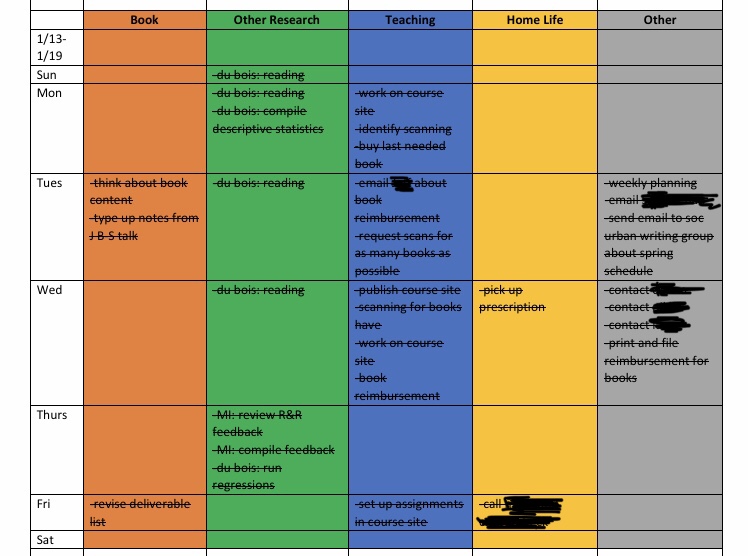
After ditching the calendar block approach, I came up with a more flexible way to manage my day-to-day to dos that I still use today.  The solution that worked for me is pretty low tech. Each semester, I make a table in Word with a color coded column for each of my broader responsibilities like book project (previously dissertation), other research, teaching, home life, and other.  The rows in the table include a week level summary in which I note any hard deadlines in the appropriate column and then a row for each day of the week. I combine work and personal in this list since many personal things have to happen during business hours such as making doctor’s appointments.  

Every Monday morning, I take about 15 minutes to plan what I’m going to work on over the course of the week.  I map each specific task to the days and try to take into account other time commitments I have. As I complete tasks, I use the strikeout format to cross out what I’ve finished and I move around anything that is incomplete to the next day I can get to it.  I also add tasks as I realize what I thought was one step is really three. I like the flexibility of Word because when things takes longer than expected, as they often do, I can copy and paste the task from one day to the next.

These days I’ve been using this Word table and red calendar appointments on the days I have hard deadlines. When I have a longer list of deadlines as I did when I was applying to fellowships, jobs, and postdocs, I use RTM, but I no longer use it for one off deadlines for journal reviews, resubmissions, and CFP deadlines.  

What I’ve described here is my custom made time management system.  You can find your own custom time management by trial too. Remember that time management experts recommend only making one major change at a time and trying that change for at least 30 days before you decide it’s not working.  Part of why it took me years to perfect my system is I tried every new aspect for a semester rather than changing systems mid-semester. Whether you give it that long is up to you, but 30 days is a fair trial period. At the end of 30 days, assess what is working and what isn’t.  Make adjustments and try again. It’s worth the time and energy to find a system that works for you!

Every so often, I see or hear comments to the effect of, why does [insert top 10 private school name] get more placements at other top 10s than [insert top 10 public school name]?  While ranking suggest that these programs should be comparable in their placements, rankings don’t capture any information about how graduate students are funded or the implications of those funding streams for job placements.  To illustrate this point, let me tell you a little about graduate student funding at two departments that I’ve now been in as examples: the Sociology departments at UC Berkeley and NYU.

Berkeley Sociology PhD students are funded for most of their time through teaching positions.  Although some students win fellowships (internal or external) or serve as research assistants, most serve as teaching assistants or as instructors for as many as 4 years (8 semesters).  In contrast, NYU PhD students receive a fellowship grant and can make extra money serving as teaching assistants or as instructors on top of their fellowships. I don’t have figures on how many semesters NYU PhD students teach, but if we conservatively estimate that it’s, at most, half of the time Berkeley students teach that would be about 2 years/4 semesters.

The difference between 4 years of teaching and 2 has implications for both publishing and time to completion.  Publishing in top tier journals takes time. Not only do reviews for the top journals take 6-9 months alone, but preparing a manuscript to be ready for a top tier journal takes numerous drafts and feedback particularly in the beginning stages of one’s career when students are learning how to construct a journal article and conduct empirical research.  Similarly, completing research for a Master’s paper and dissertation, studying for qualifying exams, and drafting a prospectus for a dissertation take time. Students at programs with funding like NYU can put closer to 100% of their time into working on all of these things, while students at programs with funding like Berkeley are more likely spending closer to 50% of their time on these activities.  Obviously students with more time to invest towards a programmatic goal or publication are likely to complete said goal or publication faster.

As a side note, I have no complaints about the teaching loads at public universities as a graduate of such an institution.  It’s important to learn how to teach through both professionalization and practice. If you ask me, students who teach as graduate students are better prepared for the balance required in tenure track jobs because of they have experience balancing teaching and research.  What I want to emphasize here is that the higher teaching demands on the public school graduate students can mean having few publications placed at less prestigious journals in comparison with comparable private institutions.

So, on average Berkeley sociology PhDs take 8 years.  (There are some other factors that go into this average that I won’t detail here.)  Additionally, most Berkeley grads are less competitive for top 10 jobs because few have top generalist journal publications (e.g., ASR, AJS, Social Problems, Social Forces) due to professionalization pressures to get something published and having to move things out the door before they are ready for a top journal publication.  Most grad students are publishing in excellent subfield journals, but top 10 programs generally want a top generalist solo publication to consider a job candidate.  Because the private school students have more time for research, they are more likely to have a CV that’s competitive at the top 10 schools, which explains differences in placement.  

While I’ve focused on the top 10s here, these disparities in funding and publications extend beyond the top 10 programs.  Graduate students from programs with funding tied teaching are going to have CVs that look markedly different than those from programs with fellowship based funding on average.  This is something that search committees can consider when looking at job applicants. CVs provide information about fellowships, teaching loads, publications, and service that should be considered to better understand what an applicant did with the resources they had.  

Most advice on academic writing starts with something like “write every day even if only for 10-15 minutes.”  The idea behind this is that we all need to practice our craft in order to master it, so we should write regularly just as someone training for a marathon needs to run regularly. The advice is sound and logical, but writing every day doesn’t work for everyone.

I tried to write every day during my early years in graduate school and felt guilty when it didn’t work for me. Ironically, the guilt was the worst on days that I spent most of my time doing data cleaning, coding data, or making tables related to my latest research project. It was all time well spent, but I wasn’t putting words on a page.  To move past the feeling of guilt, I had to recognize that this common advice was not for me and figure out a workflow that fit how I work best.

The hardest part about moving past my guilt was that so many people swear by writing every day, to the point that when I have mentioned that I don’t write every day, people assume that I’m not writing. While that certainly could be true, I still write 3-4 times a week despite the fact that I don’t write every day.  The main difference between my schedule and the schedules of those who write every day is that I don’t schedule specific times to write. I organize my schedule around tasks, which inevitably include writing as my projects are not all in the data collection and analysis stages. Each week, I pick which project(s) I need to focus on and create a to do list. Even if most of that work is about data collection or analysis, I end up writing memos to myself, documenting data collection and coding in codebooks and protocols, and writing down ideas for future analyses, papers, and chapters.

There are a few reasons why this loose approach to writing works for me. First, I’m not paralyzed by writing.  I’m what some might describe as a “word vomiter.” My first drafts are a hot mess and need a lot of editing, but I get words onto the page quickly.  (I would actually describe myself as a stronger editor than a writer, so I work best with something on the page to whip into shape.) Second, I rarely face total writing blocks.  What I mean by this is that while I experience blocks with how to articulate an idea, concept, argument, or finding, I rarely cannot write at all. When I do have a block, I can write through it with memoing to figure out what I want to say.  Third, I can pick up and put down my writing fairly easily. Writing is something I can do in spurts between when my toddler is occupied and when he needs my full attention (or wants to bang on the keyboard with me). (He is currently sitting on my shoulders as I line edit this post.) So squeezing in writing where it fits works for me (and for my schedule as a working mom).  Finally, it’s a lot harder for me to pick up and put down data cleaning, coding, and analysis work. I like longer and concentrated periods of working with my data. Once I start on a data analysis task, I work best by continually plowing forward until it’s done. These traits about my optimal work style make writing when it fits in work for me.  

In practice, writing “when it fits in” means writing several times a week. For example, last semester, I taught one course that was a new prep as part of my postdoc, so my Mondays (until around 2:30pm), Thursdays, and Fridays were dedicated to course prep and grading.  Monday afternoons, Tuesdays, and Wednesdays, I worked on my research including data collection, analysis, table/figure creation, reading literature, memoing, and writing manuscripts. Most weeks I wrote 2-3 days a week whether it was memoing or writing for a manuscript.  Even without writing every day, I wrote a new manuscript based on data analysis I had completed over winter break, revised 2 manuscripts that had been rejected and submitted them for review, drafted and submitted an extended abstract for a conference, and wrote a data-supported essay that you can read on Conditionally Accepted.

Now just because this system works for me, doesn’t mean it’s the best approach for everyone, just as writing every day doesn’t work for all writers.  Here are a few questions to ask yourself in determining what would work best for you:

  1. Do you procrastinate around writing?  
  2. Is writing agonizing?  
  3. Are you a product writer, that is someone who prefers perfecting a sentence before writing the next one?
  4. If you start writing something and don’t finish it, is it hard to pick it back up days later?

If you answered yes to any of these questions, you should try writing every day.  If you answered no to all of these questions, you might find that a more fluid approach works for you.  Just remember, there is no one size fits all in writing or research. Find what works for you!

At the end of 2018, I was on a panel about graduate school.  While I enjoyed providing guidance to these potential future graduate school applicants, I was left with a nagging feeling that I had not sufficiently addressed one comment that arose in the discussion.  When one attendee asked about the choice between an academic and a non-academic career post-PhD, several of my co-panelists commented that they chose a non-academic career because they wanted to “make a contribution.”  At the time, my response focused on the influence academics have through teaching by contributing to how young people view the world around them and how it works. But after the panel, I had a lingering distaste in my mouth about the notion that academic research does not “make a contribution.”

Now in my panelists’ defense, non-academic researchers, particularly those at policy research organizations, often have more direct access to practitioners and politicians than academics for a couple of reasons.  Policy research organizations have reputations and a following, which makes it easier to get their policy briefs and reports into the hands of policy makers and researchers even if the individual researchers on a particular project do not have connections to those people and organizations.  These organizations also often have departments that specialize in research dissemination to get their reports and briefs to organizations and politicians who are interested in the policy issues they study.

In contrast, academics have four options when it comes to reaching practitioners and politicians.  1) They can target their work to journals that are read by practitioners and politicians. 2) They can communicate with journalists to get their research covered in mainstream news outlets like the New York Times. 3) They can network with practitioners and politicians to distribute their research to potentially interested individuals.  4) They can work directly with non-profits or other organizations for their research project. It is often a more time consuming process for an academic to reach these audiences, but it does happen. William Julius Wilson, a prominent Professor of Sociology who studies poverty and race, is well known among practitioners and politicians alike despite not being a non-academic researcher.  So even though it might take work, it is not impossible.  

But the part of the conversation that got to me is that doing research that is read by practitioners and politicians is not the only way to “contribute” as a researcher.  In fact, there are three ways that academics contribute from within the academy. First is related to what happens in the classroom, which is arguably half the job. Formulating and teaching a class of 20 somethings is shaping how they think, how they see the world, and ultimately what they choose to do with their lives. Most practitioners and most politicians are college-educated, so it seems to me that Ph.D.s who choose an academic career are influencing practitioners and politicians.

Second, academic research is often what is taught in undergraduate classrooms, particularly in the social sciences.  So as an academic researcher publishing in peer-reviewed journals, I have a chance to inform the next generation of college-educated Americans.  At a time when the college-educated population is growing and includes an increasingly diverse population, this is a powerful motivation for me as a woman of color studying issues of race, urbanism, and inequality.  I get to influence the narrative about how the next generation understands issues like gentrification and the racial wealth gap.  

Finally, many social scientists work with organizations to do their research. While this work is often overlooked in the acknowledgement of service in the university (and even in the way we think of what constitutes “public sociology”), it is an integral way in which academics who remain within the institute of higher ed contribute to the broader society. Now, not all of this work is done well, but the same could be said about policy research. The goal here is to not impose on the community, but to listen to the community, hear what they need, and leverage our research skills to help them get that regardless of whether this is done by a professor or a policy researcher. That doesn’t always happen. But when it does, it is a contribution.

While their contributions manifest in different ways, academics both within and outside of academia contribute to society.  Both types of contribution are needed to try to make this world a better place.